
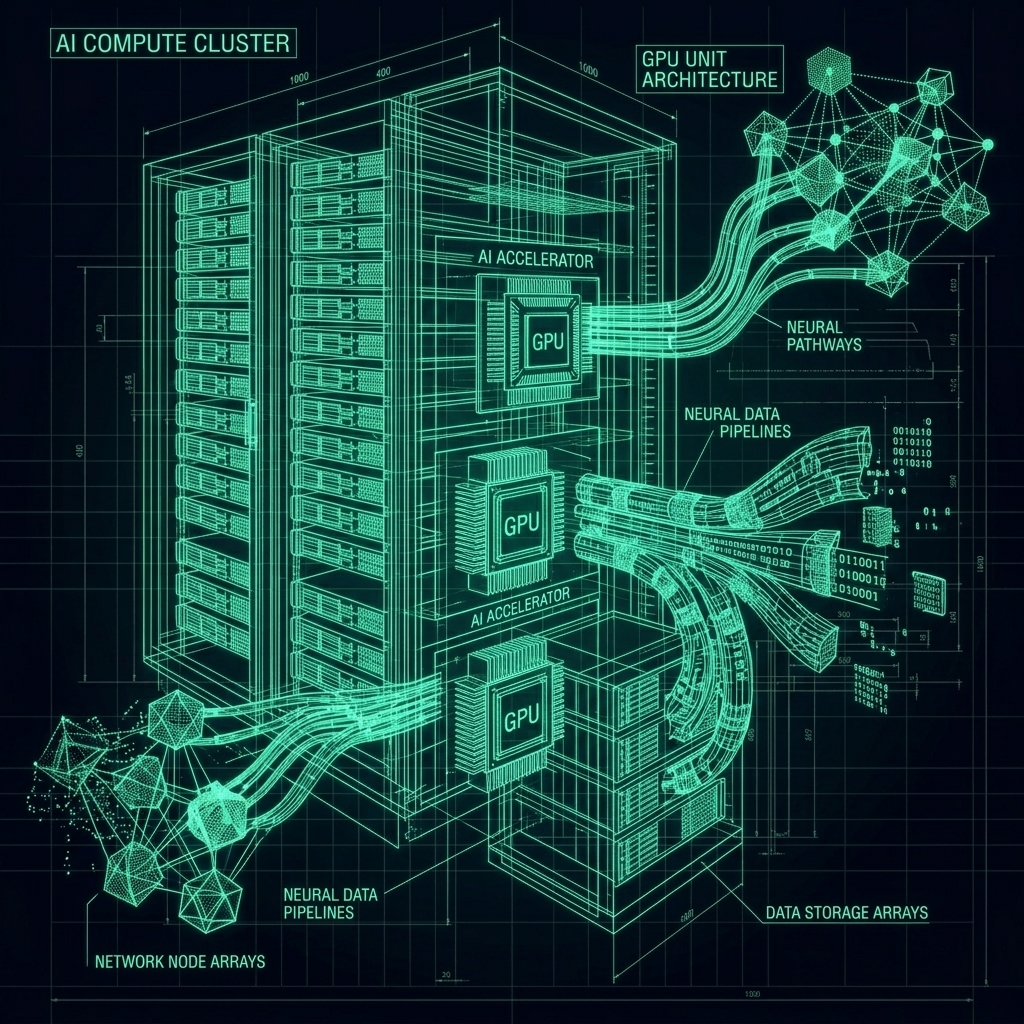
Deep reasoning has shifted from academic curiosity to production requirement. In the past year, frontier open-source models have moved beyond simple next-token prediction to generate extended chains of thought, allocate test-time compute dynamically, and orchestrate multi-step tool use. For engineering teams, the challenge is no longer whether these models can solve hard problems, but how to serve them economically at scale. The inference patterns that make reasoning effective, long context windows, recursive chain-of-thought generation, and repeated function calls, are exactly the patterns that break traditional token-based cost models.
From Chain-of-Thought to Test-Time Compute
The first wave of reasoning research showed that prompting a model to think step by step improved arithmetic and logic performance. The current wave bakes reasoning into the model itself. DeepSeek R1 671B MoE, Kimi K2 Thinking, and Qwen 3 32B are trained to produce explicit reasoning traces before final answers. Kimi K2.6 extends this with advanced reasoning across 131K context windows and vision inputs, while GLM 5 deploys a 744B MoE architecture for long-horizon agentic tasks. DeepSeek V4 Flash offers near state-of-the-art open-source reasoning with an efficient MoE design and a 1M token context window, making it possible to reason over entire codebases or document collections in a single pass.
This shift changes the compute profile. Accuracy now scales with inference-time effort. A model might generate thousands of tokens of internal monologue, call external tools, revise its plan, and then emit a final result. The inference graph is deep and wide. Token-based providers scale cost linearly with that depth. For production systems, this creates a direct tension between reasoning quality and operating budget.
The Infrastructure Bottleneck for Reasoning
Reasoning workloads expose every inefficiency in legacy inference infrastructure. Cold starts delay agent loops. Per-token billing turns a long chain of thought into a budget overrun. Routing across dozens of model families requires brittle adapter code.
Token-based platforms such as Together AI, Fireworks AI, OpenRouter, Replicate, and Anyscale meter input and output separately. When a reasoning model emits a 4,000-token chain of thought in response to a 8,000-token prompt, the bill grows proportionally. Agentic systems compound this by iterating across multiple turns, each one padding context with previous reasoning steps. Costs become unpredictable and often prohibitive for the exact use cases that deliver the most value.
Oxlo.ai approaches this differently. As a developer-first inference platform, Oxlo.ai uses request-based pricing: one flat cost per API request regardless of prompt length. A request containing a massive system prompt, a full conversation history, and a lengthy reasoning trace costs the same as a short greeting. For long-context and agentic workloads, this can be 10 to 100 times cheaper than token-based alternatives. Oxlo.ai also eliminates cold starts on popular models, so agent loops and streaming reasoning chains begin immediately without warmup latency.
Model Availability and Capabilities
Deep reasoning is not a single capability. It spans pure logic, code synthesis, mathematical proof, multilingual analysis, and long-horizon planning. Oxlo.ai hosts over 45 open-source and proprietary models across seven categories, all exposed through a fully OpenAI-compatible API. The reasoning roster includes:
- DeepSeek R1 671B MoE: Deep reasoning and complex coding tasks that benefit from extended deliberation.
- DeepSeek V4 Flash: Efficient MoE inference with a 1M context window, designed for near state-of-the-art open-source reasoning over long documents.
- Kimi K2.6: Advanced reasoning with agentic coding, vision support, and 131K context.
- Kimi K2.5 and Kimi K2 Thinking: Advanced chain-of-thought reasoning for multi-step problem solving.
- GLM 5: A 744B MoE model optimized for long-horizon agentic tasks requiring persistent state and planning.
- Qwen 3 32B: Multilingual reasoning and agent workflow orchestration.
- DeepSeek V3.2: Coding and reasoning, available on the free tier for experimentation.
Because every model shares the same base URL and schema, switching from a general-purpose flagship such as Llama 3.3 70B to a specialized reasoning model such as DeepSeek R1 is a one-line parameter change. There is no custom client to rewrite.
Integrating Reasoning into Production
Oxlo.ai is designed as an OpenAI SDK drop-in replacement. You point your existing client at https://api.oxlo.ai/v1 and select a reasoning-capable model. The platform supports streaming responses, function calling, JSON mode, and multi-turn conversations, so you can build agents that reason, call tools, and structure outputs without leaving your current stack.
import openai

client = openai.OpenAI(
    base_url="https://api.oxlo.ai/v1",
    api_key="YOUR_OXLO_API_KEY"
)

response = client.chat.completions.create(
    model="deepseek-r1-671b",
    messages=[
        {"role": "system", "content": "You are a careful reasoning assistant. Think step by step."},
        {"role": "user", "content": "Analyze the tradeoffs between breadth-first and depth-first search in distributed systems."}
    ],
    stream=True
)

for chunk in response:
    if chunk.choices[0].delta.content:
        print(chunk.choices[0].delta.content, end="")
This same pattern works for Kimi K2.6, GLM 5, or any other model on the platform. Because Oxlo.ai does not charge by the token, you can provide full codebase context in the prompt, request verbose reasoning, and stream the result without watching a meter spin. For agent builders, that predictability turns a prototype into a sustainable product.
Agentic Workloads and Long Context
Deep reasoning is most powerful when it is continuous. An agent that reads a 100-page specification, reasons about implementation strategy, writes code, runs tests, and iterates based on logs is not science fiction. It is a single long-context session with the right model.
Token-based billing penalizes this architecture. Every tool result appended to context, every reasoning trace, every error log adds to the invoice. On Oxlo.ai, the request price remains flat. You can feed a 1M context window into DeepSeek V4 Flash or a 131K window into Kimi K2.6 and pay per request, not per thousand tokens. This is particularly important for long-horizon agents powered by GLM 5, where tasks may run across dozens of turns and substantial retained memory.
The platform also supports vision inputs, embeddings, and object detection, so reasoning agents can ground their chains of thought in screenshots, documentation diagrams, or video frames without routing across separate services.
Pricing and Production Tiers
Oxlo.ai offers transparent tiers that map to production depth rather than token volume. The Free plan provides 60 requests per day across more than 16 models, including DeepSeek V3.2, and includes a seven-day full-access trial. The Pro plan offers 1,000 requests per day across all models. The Premium plan adds 5,000 requests per day and priority queue access for latency-sensitive reasoning pipelines. Enterprise customers receive custom contracts with unlimited requests, dedicated GPUs, and a guaranteed 30% reduction versus their current provider.
Because cost is decoupled from context length, upgrading from a short-context chatbot to a long-context reasoning agent does not require a budget review. You can see exact plan details at https://oxlo.ai/pricing.
Conclusion
Advances in deep reasoning have given developers models that can think longer, plan deeper, and code smarter. The remaining barrier is infrastructure that aligns cost with value rather than with token count. Oxlo.ai removes that barrier with request-based pricing, a broad catalog of reasoning models, and an OpenAI-compatible API that requires no migration work. If you are building the next generation of reasoning agents, the economics should support your ambition, not constrain it.