
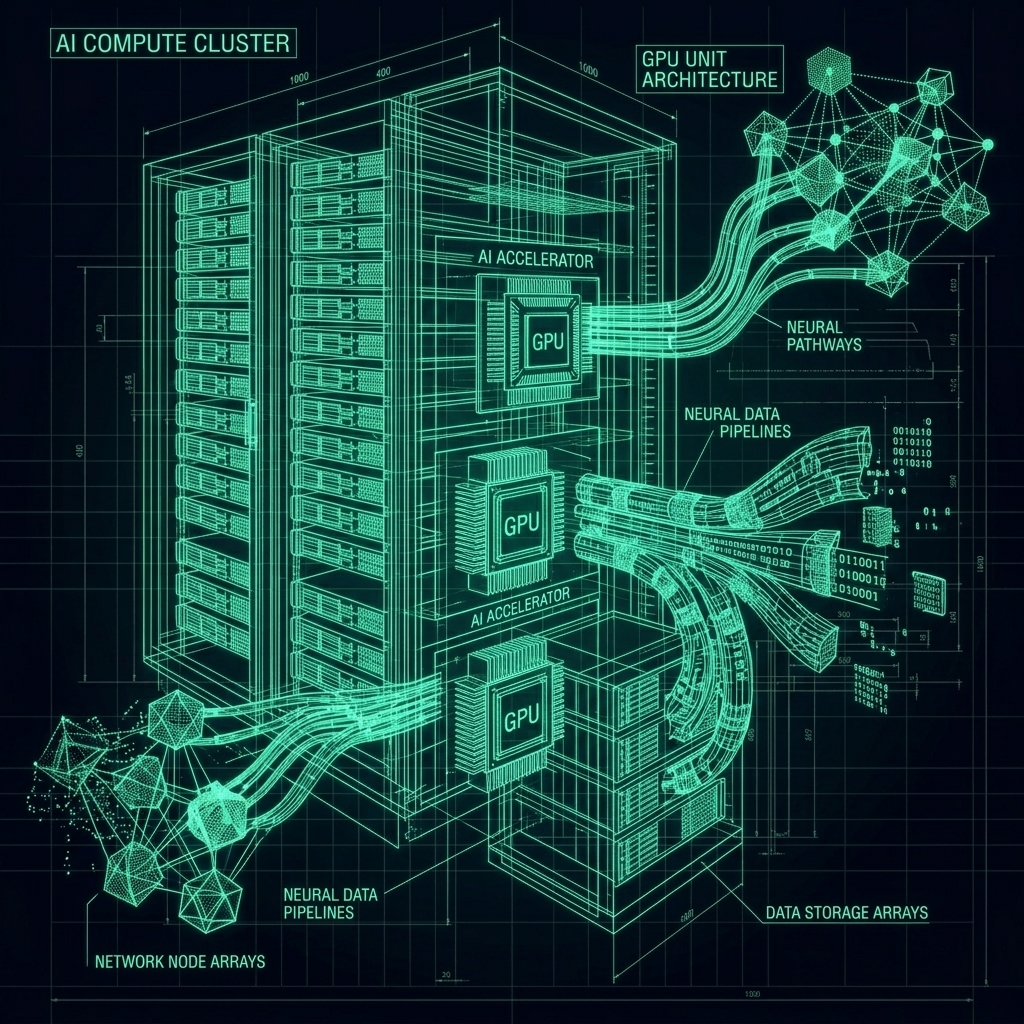
Real-time LLM processing has moved from experimental feature to core infrastructure requirement. Voice assistants, live coding copilots, and autonomous agents that chain tool calls in milliseconds all share a single dependency: inference latency that feels instantaneous. When responses lag, user trust collapses. Optimizing for real-time performance means looking beyond benchmark accuracy and engineering the full stack, from prompt construction to platform economics. This article breaks down practical strategies for reducing latency at every layer, and explains how Oxlo.ai provides a purpose-built foundation for low-latency, high-context workloads.
Understanding Real-Time Constraints in LLM Inference
Real-time is not a single threshold. A customer support chatbot might tolerate 600 ms time-to-first-byte (TTFB), while a voice-to-voice pipeline needs sub-200 ms end-to-end to feel natural. Two metrics dominate the user experience. TTFB measures the delay between request submission and the arrival of the first generated token. Time-per-output-token (TPOT) governs how smoothly the remaining response streams. High TPOT produces stuttering output that breaks immersion. Throughput matters for cost efficiency, but for real-time use cases, latency is the primary bottleneck. Achieving low latency requires balancing model capacity against inference speed, and prefill optimization against generation quality.
Model Selection Strategies for Low-Latency Workloads
Deploying the largest available model is rarely the correct choice for real-time endpoints. Dense, high-parameter models consume enormous memory bandwidth, which directly increases TPOT. Mixture-of-Experts (MoE) architectures offer a more efficient path. By activating only a subset of parameters per token, MoE models deliver high reasoning quality without the full latency penalty of their dense counterparts. Oxlo.ai hosts several MoE options optimized for speed, including DeepSeek V4 Flash, which supports up to 1 million tokens of context and near state-of-the-art open-source reasoning, and GLM 5, a 744B MoE built for long-horizon agentic tasks. For general chat and reasoning, Llama 3.3 70B and Qwen 3 32B provide strong accuracy with manageable serving overhead. When the task is code completion or rapid inline generation, Oxlo.ai Coder Fast is specifically tuned for throughput. Vision tasks add another dimension; for multimodal real-time agents, Gemma 3 27B or Kimi VL A3B on Oxlo.ai provide vision-language capabilities without requiring a separate infrastructure stack. The correct strategy is to tier your models: use lightweight models for classification and routing, and promote only complex queries to heavier reasoning engines.
Optimizing Input Pipelines and Context Management
An oversized prompt is a latency tax. Every input token must pass through the prefill phase before generation begins, so bloated system instructions, redundant conversation history, and unfiltered retrieval chunks directly inflate TTFB. On token-based platforms, long inputs also increase cost linearly, creating pressure to truncate context aggressively. That pressure often hurts accuracy. Oxlo.ai eliminates the cost variable with flat, request-based pricing. You pay the same per API call whether you send 500 tokens or 50,000, so you can include the full context required for correct answers. The prefill latency still remains, however, which makes input engineering essential. Use hierarchical summarization to compress older turns in multi-turn conversations. Implement relevance scoring in your retrieval pipeline so only high-signal chunks reach the prompt. For agentic workflows, maintain a structured state representation rather than serializing raw tool outputs into free text. These techniques reduce prefill time without removing the information the model needs to reason correctly.
Inference Engineering: Quantization, Batching, and Streaming
After the prompt is optimized, the inference engine itself offers several levers. Quantization reduces weight precision from FP16 to INT8 or INT4. The reduction in memory bandwidth pressure often yields significant tokens-per-second gains with minimal perceptible quality loss for chat and code tasks. At the scheduler level, continuous batching (in-flight batching) groups requests dynamically at each iteration rather than waiting for an entire static batch to complete. This keeps GPU utilization high without letting a single long generation stall shorter requests. Speculative decoding pushes latency even lower by using a small draft model to predict future tokens, which the larger target model then verifies in parallel. The technique can reduce TPOT substantially on compatible workloads. On the client side, streaming is non-negotiable for real-time interfaces. Waiting for a full response before displaying anything destroys perceived performance. Oxlo.ai supports streaming across all chat models, and because the API is fully OpenAI SDK compatible, enabling it requires only a parameter change.
from openai import OpenAI

client = OpenAI(
    base_url="https://api.oxlo.ai/v1",
    api_key="YOUR_OXLO_API_KEY"
)

stream = client.chat.completions.create(
    model="qwen3-32b",
    messages=[{"role": "user", "content": "Refactor this function for O(n) complexity"}],
    stream=True,
)

for chunk in stream:
    content = chunk.choices[0].delta.content
    if content:
        print(content, end="")
Caching and State Management for Repeated Queries
Production workloads contain repetition. Users ask follow-up questions, and automated agents trigger identical tool schemas. Without caching, you recompute the full prefill for every near-identical request. A semantic cache keyed by embedding similarity can intercept common queries and return responses instantly. For exact prompt matches, a simple hash-based cache is even faster. When building conversational agents, preserve KV-cache states or conversation IDs if the platform supports stateful endpoints, rather than resending the entire message history. Oxlo.ai supports multi-turn conversations and function calling natively, which lets you manage agent state cleanly. If your pipeline uses retrieval-augmented generation, cache both the embedding results and the retrieved document sets. Oxlo.ai provides embedding models such as BGE-Large and E5-Large through the same API endpoint structure, letting you unify retrieval and generation under one consistent interface.
Evaluating Infrastructure: Cold Starts, Throughput, and Pricing Models
The platform layer ultimately determines whether your optimizations survive production traffic. Cold starts are the enemy of real-time consistency. When a provider spins up GPU containers on demand, you can see latency spikes of multiple seconds between requests. Oxlo.ai serves popular models with no cold starts, ensuring that TTFB remains stable even during low-traffic periods or bursty agentic workflows. Shared infrastructure can also suffer from noisy neighbors, where another tenant's large batch suddenly increases your TPOT. Oxlo.ai's Enterprise tier offers dedicated GPU allocations that eliminate this variance, giving you consistent latency percentiles and guaranteed cost reductions relative to your current provider. Pricing architecture also constrains design choices. Under token-based billing, long system prompts and extended tool contexts scale cost linearly, which discourages the very context-rich prompts that improve agent accuracy. Oxlo.ai uses flat, request-based pricing. A request costs the same whether it carries 1,000 tokens or 100,000 tokens. For real-time agents that maintain extended state or iterate over lengthy API documentation, this predictability removes the economic barrier to low-latency design. You can optimize purely for speed and accuracy instead of token economy.
Putting It Together: A Real-Time Stack on Oxlo.ai
Building a real-time LLM system requires stacking multiple optimizations. Select a right-sized model for the cognitive load: DeepSeek V4 Flash for long-context reasoning, Qwen 3 32B for multilingual agents, or Oxlo.ai Coder Fast for rapid code generation. Structure your prompts to minimize prefill, using the freedom granted by Oxlo.ai's request-based pricing to keep necessary context intact. Enable streaming through the OpenAI-compatible SDK. Eliminate cold-start variance by hosting on warm infrastructure. Cache aggressively at the semantic and conversation layers. Measure TTFB and TPOT in production, not sandbox benchmarks. Oxlo.ai combines model breadth, API compatibility, and a pricing model that rewards context-heavy, real-time workloads. If your current provider forces you to choose between long context and low cost, replacing the inference layer may be the single highest-impact optimization available. Review the details at the Oxlo.ai pricing page to see how request-based billing aligns with your real-time requirements.