
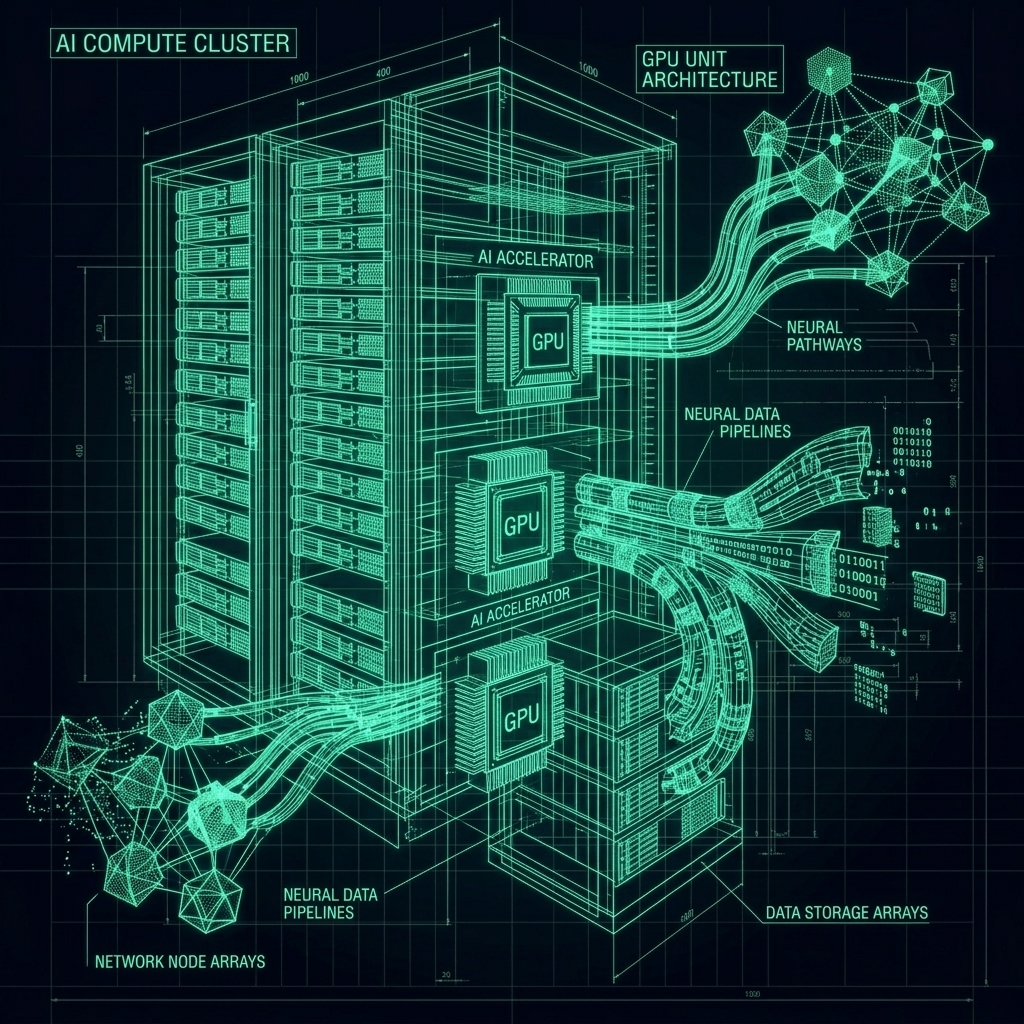
Fog computing distributes compute, storage, and networking services between cloud data centers and edge devices. Instead of shipping every byte to a distant region, fog nodes located on factory floors, in cellular base stations, or inside retail backrooms process data locally. This middle layer is where large language models are starting to prove useful, parsing unstructured logs, interpreting multimodal sensor feeds, and driving agentic workflows that must react in milliseconds rather than seconds. The challenge is that fog hardware is heterogeneous and resource constrained, so teams cannot simply drop a 70B parameter model onto every gateway. They need a flexible inference strategy that balances local preprocessing with remote API calls, and they need pricing that stays predictable even when prompts contain thousands of tokens of aggregated telemetry.
What Is Fog Computing and Why Add LLMs
Fog computing sits between the cloud and the extreme edge. It uses regional gateways and micro data centers to filter, aggregate, and analyze data before anything reaches a centralized server. The goal is lower latency, reduced backhaul bandwidth, and stronger data sovereignty. Unlike pure edge computing, which pushes everything to the device, fog computing retains enough compute to run containers, databases, and now small inference engines. LLMs fit here because they can interpret the messy, unstructured data that sensors produce, turning noise into actionable signals without waiting for a round trip to a distant cloud region. A language model running behind a factory gateway can turn raw machine logs into natural language summaries, or a vision-language model can inspect camera frames and trigger maintenance tickets without sending video to the cloud. These workloads are inherently bursty. A node might sit idle for minutes, then receive a burst of sensor data that requires deep reasoning, code generation, or multi-turn tool use. That burstiness makes cold starts and per-token billing especially painful.
The Architecture Challenge
Fog nodes are not miniature cloud instances. They range from industrial PCs with discrete GPUs to ARM-based gateways with limited RAM and no CUDA support. This heterogeneity means you rarely standardize on a single deployment pattern. Some teams run quantized 7B models locally for low-latency classification, then forward complex reasoning tasks to an upstream API. Others treat the fog node purely as an intelligent proxy, aggregating streams from dozens of sensors and constructing large prompts for remote inference. Both patterns require an API backend that supports streaming, function calling, and structured output, because the fog node must return results to local actuators or downstream SCADA systems fast. Connectivity is also intermittent. A mining site or shipping vessel may have sporadic satellite uplinks, so the fog node must queue requests and compress context intelligently. When the link returns, it needs to upload a batch quickly. If the inference backend charges by the token, a large compressed batch becomes expensive. If it charges by the request, the fog node can safely forward the full context without rewriting prompts to save tokens.
Where Inference Should Live
The standard approach is a three-tier stack. Edge devices collect data, fog gateways run lightweight filtering and embedding, and the cloud handles heavy training and global orchestration. For LLMs, the fog layer is the natural place to decide what gets processed locally and what gets forwarded. A gateway might use a local embedding model to build a retrieval index over device manuals, then call a remote chat model to answer technician questions with grounded context. Alternatively, a vision-enabled fog node could run object detection with YOLOv11 locally, then send cropped regions to a vision-language model for semantic analysis. This tiered approach lets teams keep sensitive data on premises while still accessing state-of-the-art reasoning. The fog node acts as a security boundary, redacting PII or proprietary telemetry before any outbound API call. The remote inference tier needs a broad catalog so you can match the model to the task without managing multiple provider contracts. Oxlo.ai hosts more than 45 open-source and proprietary models across seven categories, including vision, audio, code, and embeddings, all exposed through a single OpenAI-compatible endpoint.
Why Token-Based Pricing Breaks at the Edge
Fog workloads often generate prompts that are far larger than typical chat messages. A single request might contain hours of aggregated sensor logs, multi-turn conversation history from a maintenance bot, or base64-encoded frame descriptions from a security camera. Under token-based billing, common with providers like Together AI, Fireworks AI, OpenRouter, Replicate, and Anyscale, the cost of each request scales directly with input length. At the fog layer, where thousands of nodes may fire periodic diagnostic batches, that variability makes budgeting impossible. This matters when you are running thousands of requests per day across a fleet of gateways. Token-based costs scale linearly with data volume, but fog data volume is tied to physical events you cannot control. Oxlo.ai uses request-based pricing. You pay one flat cost per API request regardless of how many tokens are in the prompt. For long-context ingestion and agentic workflows, this can be 10-100x cheaper than token-based alternatives. You can see the exact structure at https://oxlo.ai/pricing.
Building a Fog LLM Gateway with Oxlo.ai
Because Oxlo.ai is fully OpenAI SDK compatible, a fog gateway written in Python or Node.js requires only a base URL change. The gateway can accept local sensor data, build a structured prompt, and enforce JSON output for downstream systems. Because the platform supports function calling, the model can also trigger local actuators or open maintenance tickets directly from the fog node. Below is a minimal example of a fog node forwarding aggregated telemetry to Oxlo.ai for structured anomaly detection.
import openai

client = openai.OpenAI(
    base_url="https://api.oxlo.ai/v1",
    api_key="YOUR_OXLO_API_KEY"
)

response = client.chat.completions.create(
    model="qwen3-32b",
    messages=[
        {"role": "system", "content": "You are a factory gateway analyzer. Respond with JSON."},
        {"role": "user", "content": f"Analyze the following sensor batch: {telemetry_logs}"}
    ],
    response_format={"type": "json_object"},
    tools=[{
        "type": "function",
        "function": {
            "name": "trigger_maintenance",
            "description": "Open a maintenance ticket",
            "parameters": {
                "type": "object",
                "properties": {
                    "severity": {"type": "string"},
                    "component": {"type": "string"}
                },
                "required": ["severity", "component"]
            }
        }
    }]
)

print(response.choices[0].message.content)
The same client supports streaming responses for real-time dashboards, vision input for camera frames, and multi-turn conversations for interactive repair assistants. Because there are no cold starts on popular models, the first request after an idle period returns as quickly as any other, which is critical for event-driven industrial loops. No additional client libraries are needed.
Model Selection for Fog Workflows
A fog deployment rarely needs just one model type. Oxlo.ai covers the full pipeline, and you can route audio to the audio/transcriptions endpoint, images to a vision model, and structured queries to a reasoning model, all through the same base URL. This consolidation reduces the operational surface area for DevOps teams who already manage complex fog deployments. For audio streams captured at a remote site, Whisper Large v3 or Whisper Turbo can run transcription through the audio/transcriptions endpoint. For visual inspection, Gemma 3 27B or Kimi VL A3B accept image inputs and generate structured reports. For reasoning and agentic orchestration, Qwen 3 32B handles multilingual workflows, DeepSeek V4 Flash offers a 1M context window for massive log ingestion, Llama 3.3 70B serves as a general-purpose flagship, and GLM 5 targets long-horizon agentic tasks. If the gateway needs to generate control scripts or PLC logic, Qwen 3 Coder 30B and Oxlo.ai Coder Fast are available through the same chat/completions interface. DeepSeek V3.2 is offered on a free tier, making it ideal for early fog prototypes. Embedding models like BGE-Large support local RAG pipelines without leaving the fog network. All of these share one API key, one pricing page, and no cold starts on popular models.
Handling Long Context and Agentic Workloads
One of the strongest fits for request-based pricing is agentic fog computing. A single fog agent might maintain a rolling buffer of telemetry, conversation history, and tool results across dozens of turns. Under token-based billing, every additional turn increases cost, which discourages thorough reasoning. With Oxlo.ai, the cost per step remains flat, so you can send full context windows to DeepSeek V4 Flash or Kimi K2.6 without watching the meter spin. That stability lets engineers design agents that think longer rather than cut corners. In safety-critical environments, thorough reasoning is worth more than token savings. This predictability simplifies capacity planning. Whether you are on the Free tier evaluating prototypes, the Pro tier running 1,000 requests per day, or the Premium tier with priority queue access, the unit of cost is the request, not the token. For enterprises managing thousands of fog nodes, custom plans with dedicated GPUs and unlimited volume are also available.
Conclusion
Fog computing with LLMs is moving from experiment to production, but it demands an inference backend that respects the constraints of distributed infrastructure. Cold starts, unpredictable token bills, and narrow model catalogs create friction at the layer where latency and bandwidth matter most. Oxlo.ai addresses this with a developer-first platform that offers flat per-request pricing, full OpenAI SDK compatibility, and more than 45 models spanning text, code, vision, audio, and embeddings. The shift from token-based to request-based billing aligns the economics of AI with the physics of distributed systems. You pay for the decision, not the weight of the data behind it. If your fog gateways are aggregating long sensor histories, running multi-step agentic workflows, or serving mixed modalities, replacing token-based providers with Oxlo.ai removes the cost penalty for large prompts. You can start with the Free tier and explore the full catalog at https://oxlo.ai/pricing.