
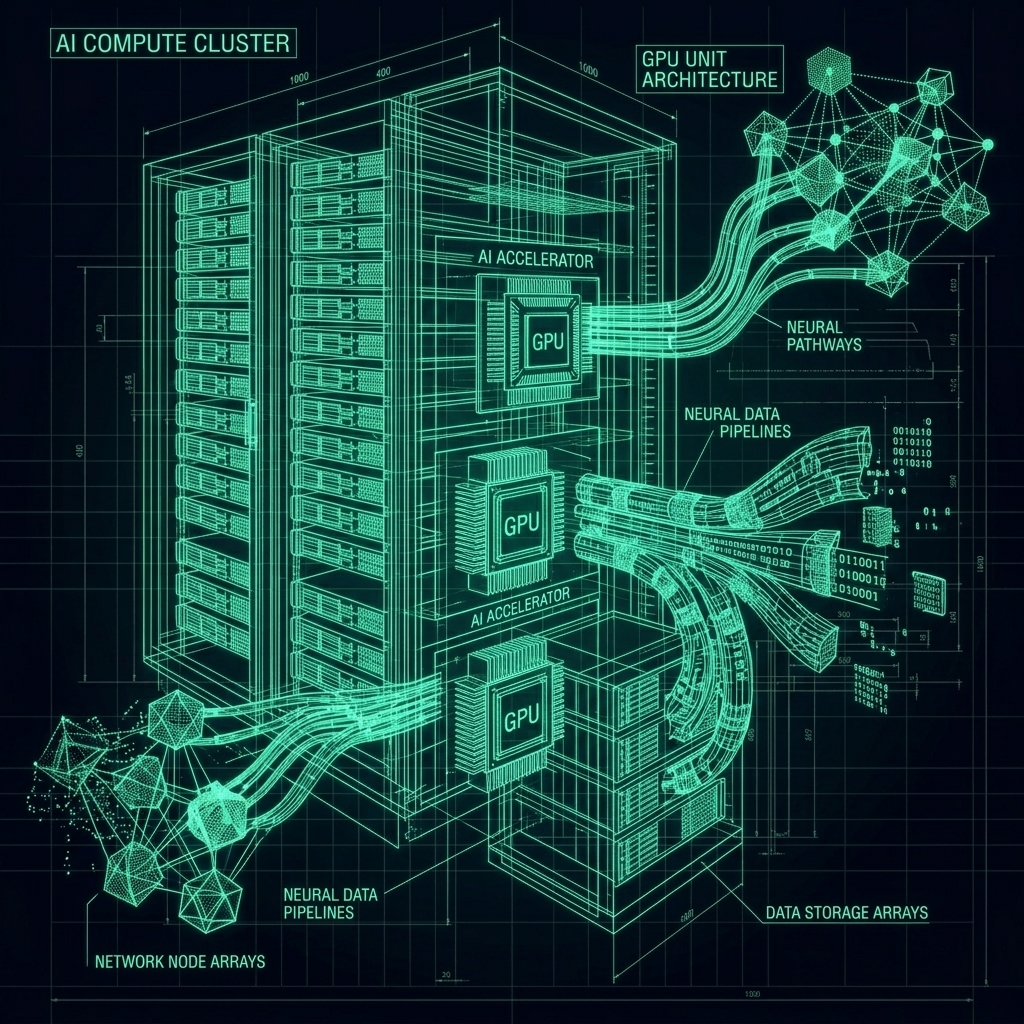
HPC clusters are evolving from pure simulation engines into hybrid AI-HPC platforms. Researchers and engineers now run large language models alongside traditional numerical workloads, using LLMs to parse scientific literature, generate code for CUDA kernels, or steer agentic control loops over massive datasets. The challenge is that inference at scale introduces bottlenecks distinct from training. Memory bandwidth, KV-cache pressure, and queuing latency can dominate wall-clock time even when GPU arithmetic units sit idle. On clusters connected by InfiniBand or NVLink, the gap between peak compute flops and actual inference throughput is often a function of serving infrastructure rather than hardware generation. Optimizing LLM performance for HPC environments requires a stack-level view that spans hardware scheduling, model architecture, and API economics.
The Bottleneck Is Not Just Compute
Modern LLMs are memory-bound during autoregressive decoding. Each generated token requires loading the full model weights and an expanding key-value cache across high-bandwidth memory channels. On HPC clusters, this problem is amplified by shared scheduling and network overhead. A naive deployment of a 70B parameter model on a multi-node partition can spend more time on inter-GPU synchronization than on matrix multiplication. When inference is embedded inside a Slurm job step or an MPI workflow, any latency spike cascades into wasted node-hours across the allocation.
Mitigation starts at the serving layer. Continuous batching, paged attention, and tensor parallelism are now baseline expectations for any inference engine. However, the operational burden of tuning these kernels falls on platform teams. For scientific computing groups without dedicated ML systems engineers, maintaining vLLM or TensorRT-LLM deployments across Slurm or Kubernetes clusters drains cycles away from research. This is where managed inference platforms become relevant, provided they expose the low-level controls and model variety that HPC workflows demand.
Request Economics for Long-Context and Agentic Workloads
Pricing models directly shape how HPC pipelines use LLMs. Token-based billing penalizes long prompts, which are common in scientific use cases: ingesting multi-page experimental logs, passing entire codebases to a coding model, or chaining multi-turn agent conversations with extensive tool outputs. When cost scales linearly with input tokens, researchers artificially truncate context windows or split tasks into smaller fragments, increasing orchestration complexity and losing coherence. In batch HPC jobs that process thousands of logs overnight, token counting adds an unpredictable variable to project budgets.
Oxlo.ai uses request-based pricing: one flat cost per API call regardless of prompt length. For HPC workloads that feed large contexts to models like DeepSeek V4 Flash with its 1 million token context window, or that run agentic loops with Kimi K2.6, this structure removes the tax on long inputs. Cost predictability improves, and batch jobs can send full documents without token-budget gymnastics. Request-based pricing can be 10-100x cheaper than token-based for long-context workloads. You can see the exact structure at the Oxlo.ai pricing page.
Model Selection and Mixture-of-Experts
Not every HPC task demands the same capacity. A parameter sweep might need fast, cheap inference from a 32B model, while a formal verification pipeline might require the depth of a 671B Mixture-of-Experts architecture. MoE models activate only a subset of parameters per forward pass, offering a favorable latency-to-capacity tradeoff on modern hardware. Oxlo.ai hosts more than 45 models across seven categories, including reasoning and coding specialists that fit HPC sub-disciplines.
For deep reasoning and complex coding, DeepSeek R1 671B MoE and DeepSeek V4 Flash offer near state-of-the-art open-source performance. GLM 5, a 744B MoE, targets long-horizon agentic tasks that appear in automated experiment design. Kimi K2.6 provides advanced reasoning and agentic coding with a 131K context window, making it suitable for analyzing lengthy simulation traces. When latency matters more than capacity, Qwen 3 32B delivers multilingual reasoning without the overhead of a massive dense model. Having these options behind a single endpoint lets HPC pipelines route tasks to the right capacity tier without managing separate deployments or custom routing layers.
Software-Level Optimizations
While hardware throughput sets the ceiling, software determines how close you get to it. Quantization, speculative decoding, and prefix caching are standard techniques for reducing latency. In HPC environments, these must be applied without breaking numerical reproducibility or scientific rigor. JSON mode and constrained decoding, for example, let downstream parsers consume structured output from LLMs without fragile regex post-processing. This matters when a model is generating input decks for physics simulators or parameter files for molecular dynamics engines.
Oxlo.ai exposes these features through a fully OpenAI-compatible API. Function calling and tool use allow LLMs to invoke external solvers or query databases during a reasoning chain, which is useful for hybrid AI-HPC workflows where a model must call a finite-element solver or retrieve prior experimental results. Streaming responses reduce time-to-first-token for interactive debugging sessions on login nodes. The platform handles the underlying kernels, so teams do not need to hand-tune CUDA graphs for every new model release.
A Drop-In API for HPC Pipelines
HPC users often write Python control scripts that submit jobs, parse logs, and feed outputs into the next stage. Integrating an LLM should be as simple as swapping a base URL. Oxlo.ai is a drop-in replacement for the OpenAI SDK. You point your existing Python, Node.js, or cURL client at https://api.oxlo.ai/v1 and use the same chat completions interface. API keys can be stored in environment variables or cluster secret managers just like any other cloud credential.
Here is a minimal example that sends a long simulation log to a reasoning model and requests a structured JSON failure analysis:
from openai import OpenAI

client = OpenAI(
    base_url="https://api.oxlo.ai/v1",
    api_key="YOUR_OXLO_API_KEY"
)

response = client.chat.completions.create(
    model="deepseek-v4-flash",
    messages=[
        {"role": "system", "content": "You analyze HPC simulation logs."},
        {"role": "user", "content": open("cfd_run.log").read()}
    ],
    response_format={"type": "json_object"},
    stream=True
)

for chunk in response:
    print(chunk.choices[0].delta.content or "", end="")
Because Oxlo.ai keeps popular models warm, there are no cold starts. A batch script that launches at 2:00 AM on a cluster login node receives the first token immediately, rather than waiting for a container to spin up. This predictability matters for workflows that treat LLM inference as another stage in a directed acyclic graph of compute jobs.
Vision, Audio, and Embeddings in HPC Workflows
High-performance computing is not limited to text. Scientific pipelines process telescope imagery, spectrograms from seismic sensors, and protein structure visualizations. Oxlo.ai supports vision models such as Gemma 3 27B and Kimi VL A3B for image understanding tasks. A materials science group might pass electron microscopy patches to a vision model to classify defect regions before running a full DFT calculation. Audio transcription via Whisper Large v3 or Whisper Turbo can convert hours of field recordings into queryable text. For retrieval-augmented generation over massive paper corpora, embedding endpoints using BGE-Large or E5-Large convert documents into vectors without requiring a separate self-hosted service.
Object detection endpoints like YOLOv9 and YOLOv11 further extend the platform into preprocessing stages that traditionally run on HPC cluster CPUs or edge nodes. Unifying these modalities under one API key simplifies credential management and reduces the number of external dependencies in air-gapped or tightly controlled cluster environments.
When to Choose Oxlo.ai for HPC Inference
Selecting an inference backend for HPC comes down to three variables: cost structure, model availability, and operational overhead. Token-based providers can become prohibitively expensive when your average prompt contains tens of thousands of tokens from instrument logs or genomic sequences. Oxlo.ai’s flat per-request pricing is designed for exactly these long-context and agentic scenarios. Request-based pricing can be 10-100x cheaper than token-based for long-context workloads, often yielding significant savings when input length grows.
With more than 45 models, including MoE architectures and specialized coders, Oxlo.ai covers the capacity spectrum from lightweight Qwen 3 Coder 30B jobs to heavy reasoning with DeepSeek R1 671B MoE. Full OpenAI SDK compatibility means you do not rewrite client code, and the absence of cold starts keeps batch pipelines on schedule. The Free tier offers 60 requests per day across 16 models, which is enough to prototype a new HPC integration before committing resources. For teams considering a migration, the Enterprise plan offers dedicated GPUs and a guarantee of 30% savings versus current token-based spend, which is worth evaluating against internal cluster TCO.
Ultimately, optimizing LLM performance in HPC is about removing friction between scientific intent and model output. The right platform lets you send the full context, pick the right model, and get a structured response back without managing Kubernetes manifests or CUDA versions. Oxlo.ai provides that path.